
How to Build a Backyard Steel Target Range: Setup, Distance and Target Placement
21st Apr 2026
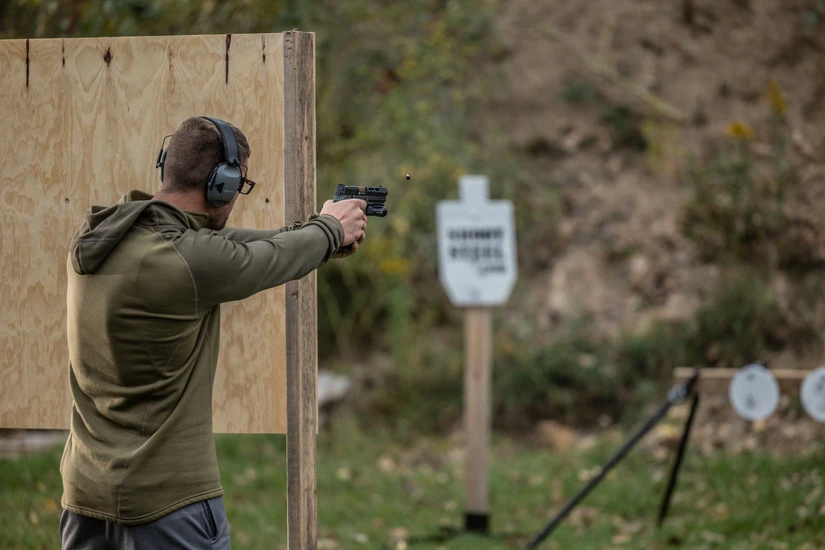
To build a backyard steel target range, start with a safe shooting direction and adequate backstop, confirm that shooting is legal on the property, then place properly rated steel targets at distances appropriate for the ammunition being used. For many Shoot Steel products, standard centerfire handguns start at 10 yards, centerfire rifles generally start at 100 yards, and higher-velocity or magnum rifles may require 150 to 200 yards or more. From there, build your steel target range setup around the firearms you shoot, the drills you run and the amount of distance available.
A good private range is not just steel plates placed in front of a hill. The backstop, shooting lane, target material, mounting system, ammunition and target condition all work together. Plan those pieces first and your range will be safer, easier to maintain and much more useful.
Step 1: Start With the Range, Not the Targets
Before buying steel, determine whether the property is appropriate for a shooting range. Local laws, zoning rules, discharge ordinances and other requirements can vary by state, county and municipality. Confirm what applies where you live before building or shooting.
Then evaluate the property itself.
A backyard shooting range needs:
- A clearly defined and controlled direction of fire
- A backstop capable of safely containing projectiles
- Enough distance for the calibers and targets you plan to use
- No roads, homes, trails, livestock areas or other unsafe locations behind the target line
- A shooting position that keeps all intended fire inside the safe impact area
- Enough width to account for multiple targets and realistic misses
Do not rely on the steel target itself as the backstop. A steel target is there to provide a reactive strike surface. The range still needs an appropriate backstop behind it.
Step 2: Build Around a Safe Backstop
The backstop is the most important part of a backyard shooting range setup. The appropriate design depends on the property, soil, terrain, expected calibers and applicable regulations.
A naturally occurring hillside can sometimes provide a useful starting point when it is large enough, free of rocks or other problematic surfaces and fully contained within the property. Constructed earth berms are also commonly used on private ranges.
The important point is that the backstop needs to extend beyond the target itself. You are planning for every shot, not only perfect hits.
When evaluating the target area, consider:
- What lies directly behind the targets
- What lies beyond the backstop
- How wide the safe impact area is
- Whether erosion could change the berm over time
- Whether rocks, hard surfaces or other materials are exposed
- Whether target positions encourage shots toward the center of the backstop
A target placed at the edge of a berm may give you enough room physically, but it creates a worse shooting lane than moving that target toward the center of the impact area.
Step 3: Determine Your Steel Target Distances
Once you know the safe direction of fire, lay out the target distances based on the ammunition you intend to shoot.
There is no universal safe distance for steel targets. Follow the specifications for the exact target you are using.
| Range Zone | Typical Use | Target Ideas |
|---|---|---|
| 10–25 Yards | Centerfire handgun training on applicable targets | Silhouettes, static plates, gongs, dueling trees, Texas Stars |
| 50 Yards | Handgun or specialized short-range rifle systems | Only use rifle targets specifically designed and rated for this distance |
| 100 Yards | Primary rifle zone on applicable targets | .223/5.56, .308 and 6.5 Creedmoor gongs and silhouettes |
| 200 Yards | Higher-velocity rifle use and intermediate long-range practice | 8", 10", 12" and larger rifle gongs |
| 300+ Yards | Long-range rifle practice | Larger gongs and high-visibility rifle targets |
Shoot Steel currently recommends at least 100 yards for common centerfire rifle cartridges such as .223/5.56, regardless of whether the plate is 3/8" or 1/2", with greater distance as velocity increases.
How Far Away Should 9mm Steel Targets Be?
For many Shoot Steel products, 10 yards is the minimum distance for standard centerfire handgun use. That makes the 10- to 25-yard portion of a private range ideal for most 9mm training.
This zone can include:
- Round gongs
- Static silhouettes
- A-zone targets
- Dueling trees
- Plate racks
- Texas Stars
You do not need every target at 10 yards. Moving targets farther away is an easy way to increase difficulty without changing the target itself.
For example, a useful handgun layout could put a large silhouette at 10 to 15 yards, several smaller plates at 15 to 20 yards and a smaller precision gong at 25 yards.
How Far Away Should 5.56 and .223 Steel Targets Be?
For conventional Shoot Steel targets rated for centerfire rifle use, 100 yards is generally the minimum starting distance for .223 and 5.56.
High velocity is the major concern. Some 5.56 and .223 loads exceed 3,000 fps at the muzzle, and Shoot Steel product ratings may require additional distance as velocity increases.
If you shoot both handgun and rifle on the same property, do not simply fire your rifle at the handgun steel because it is already downrange.
Instead, create dedicated zones:
- 10–25 yards: Handgun targets
- 100+ yards: Rifle-rated targets
That makes it visually obvious which targets belong to which shooting application.
How Far Away Should .308 Steel Targets Be?
A properly rated 3/8" AR500 target can handle .308 Win at the required distance. Shoot Steel's current 3/8" AR500 Round Gong is rated for short-action rifle cartridges through .308 Win and 6.5 Creedmoor.
For conventional flat rifle targets, 100 yards is the standard minimum starting point on applicable Shoot Steel products.
A .308 range becomes more useful when you have additional targets farther out. A basic progression might be:
- 100 yards: Smaller precision gong
- 200 yards: Medium gong
- 300 yards: 10" to 12" gong
- 400–500 yards: Larger gong for visibility and hit confirmation
If your property supports that distance, progressively placed steel gives you multiple training options without constantly moving targets.
What About Rifle Targets at 50 Yards?
Do not place a normal rifle gong at 50 yards simply because your property is not long enough for 100 yards.
Short-range rifle steel requires a system specifically designed for that application. Shoot Steel offers a purpose-built Hardox® 1/2" AR550 Short Range Rifle Target designed for 50-yard use. Its 12" x 20" target plate is fixed at a 40-degree forward angle as part of the system design.
The important distinction is that the 50-yard rating belongs to that specific target system. It does not mean a conventional 1/2" AR550 gong can automatically be moved to 50 yards.
How Should You Space Multiple Steel Targets?
There is no universal rule for how far apart steel targets should be laterally. Target spacing should be driven by the drill, available backstop and safe shooting lane.
For handgun transition drills, targets can be arranged relatively close together to encourage fast sight movement. To make the same drill more difficult, increase the lateral separation or use smaller targets.
For rifle transitions, wider spacing forces larger movements and more deliberate target acquisition.
You can also create difficulty without spreading targets farther apart:
- Mix target sizes
- Place targets at different depths
- Use smaller strike zones
- Mix static and reactive targets
- Use different target heights when the backstop safely allows it
The important limitation is the backstop. Every target should keep expected impacts and reasonable misses inside your controlled impact area.
Should All Steel Targets Be at the Same Distance?
No. A range becomes much more useful when targets are placed at different distances.
For pistol shooting, multiple depths make the shooter process target size and distance instead of running the same transition repeatedly.
For rifle shooting, targets at 100, 200 and 300 yards allow you to practice holds, optic adjustments and target identification without moving the firing position.
A mixed-depth setup is particularly useful when you have limited lateral range width. Instead of placing ten targets side by side, build difficulty by changing distance and target size.
Which Steel Target Styles Work Best on a Backyard Range?
| Target Style | Best Use | Good Mounting Option | Portability |
|---|---|---|---|
| Round Gong | General pistol or rifle practice | T-post hangers, straps or gong stand | Excellent |
| Silhouette | Practical handgun and rifle drills | Static T-post or dedicated stand | Good |
| Static Plate | Accuracy, transitions and training drills | Static hanger or stand | Excellent |
| Dueling Tree | Pistol transitions and head-to-head shooting | Purpose-built stand | Moderate |
| Texas Star | Moving-target and advanced pistol training | Purpose-built system | Moderate |
A new range does not need every target style at once. Start with a few versatile static targets, then add reactive systems once the basic layout is established.
Best Beginner Backyard Steel Target Setup
If you are starting from scratch, resist the urge to fill the entire target line immediately.
A useful first setup could include:
- One larger 3/8" AR500 silhouette for handgun drills
- Two 8" to 12" AR500 gongs
- T-post or portable mounting systems
- One dedicated rifle-rated gong at 100 yards if the property supports rifle use
That gives you several different drills without creating a complicated range.
Shoot Steel's 3/8" AR500 gongs are available in multiple sizes and are rated for centerfire handguns and short-action rifles through .308 Win and 6.5 Creedmoor at the proper distances.
T-Posts vs. Freestanding Target Stands
Mounting choice depends heavily on whether the range is permanent.
T-Post Target Systems
T-posts are one of the simplest ways to place individual targets throughout a private range. Shoot Steel's current T-Post Gong Hangers fit standard 1.25" or 1.33" T-posts and use a self-locking design that holds position under load without set screws or clamps.
T-posts work especially well when:
- The ground accepts driven posts
- You want individual targets at multiple distances
- The range will stay in roughly the same configuration
- You want to minimize the amount of stand hardware downrange
Freestanding Target Stands
A freestanding stand makes more sense when:
- The ground is too hard for T-posts
- You frequently move targets
- You want to reconfigure drills
- The range surface is gravel or another hard material
- You want a complete base and upright system
For a permanent long-range gong line, T-posts can be extremely simple. For a pistol bay that changes every weekend, portable stands offer more flexibility.
How Should Steel Targets Be Angled?
Steel targets should be mounted using the angle and hardware intended by the target manufacturer.
Hanging gongs should generally be allowed to swing freely after impact. Static systems may use a built-in forward angle or spring system. Specialized targets can use much more aggressive angles for specific applications.
Do not create a random target angle because it "looks safe." Use the system as designed.
Proper target positioning helps direct fragments toward a controlled area and keeps the plate reacting as intended.
Also inspect the strike face regularly. Pitted, cratered or badly deformed steel should not remain in service simply because the stand still holds it.
What Ammo Should You Use on a Backyard Steel Range?
Use ammunition appropriate for both the caliber rating and target design.
Do not shoot prohibited projectile types at Shoot Steel AR500 or AR550 targets, including:
- Steel-core ammunition
- Armor-piercing ammunition
- Tracer ammunition
Conventional lead-core ammunition is generally appropriate when the target is rated for the cartridge and you follow its minimum distance.
This is particularly important for 5.56 shooters. Do not assume every 5.56 load is appropriate for steel just because the target is rated for that caliber. Projectile construction and velocity matter.
How to Build a Pistol-Only Steel Range
If your range is primarily for 9mm and other common centerfire handguns, focus on target variety rather than maximum distance.
A strong handgun setup could include:
- Large silhouette at 10–15 yards
- Two smaller static plates at 15–20 yards
- Precision gong at 20–25 yards
- Dueling tree for transition work
- Texas Star for advanced reactive training
Use smaller targets and wider transitions as skill improves rather than moving steel closer.
This kind of setup works well for recreational practice, competition training and defensive handgun drills.
How to Build a Mixed Pistol and Rifle Range
A mixed range should make the separation between handgun and rifle targets obvious.
One useful layout is:
- 10–25 yards: Handgun-only reactive and static steel
- 100 yards: 3/8" AR500 rifle-rated gongs
- 200 yards: Medium rifle gong
- 300+ yards: Larger long-range gong if property permits
This lets you use the same firing area for very different training sessions while keeping rifle targets at the proper distance.
If the same physical target will be used with multiple calibers, confirm that the plate is rated for all of them and change your shooting distance accordingly.
How to Build a Long-Range Steel Target Setup
For long-range shooting, target visibility and hit confirmation become increasingly important.
Round gongs are excellent because they provide audible feedback and visible movement when properly mounted. Larger targets become easier to acquire as distance increases.
A practical progression could use:
- 8" gong at 100 yards
- 10" gong at 200 yards
- 12" gong at 300 yards
- 16" or larger target farther downrange
Those sizes are not safety requirements. Adjust target size based on shooter ability, optic magnification and the level of difficulty you want.
For high-volume rifle ranges or more demanding cartridges, consider heavier 1/2" AR500 or Hardox® AR550 targets. Current Shoot Steel Hardox® products have target-specific distance requirements, including products calling for 150 yards above 2,800 fps and 200 yards for long-action rifles.
Common Backyard Steel Range Mistakes
- Buying targets before planning the backstop. Build the safe shooting lane first.
- Assuming property size alone makes a range safe. Direction of fire, surrounding property and backstop quality matter.
- Using one target distance for every caliber. Handguns and rifles require very different minimum distances.
- Putting conventional rifle steel at 50 yards. Use only a purpose-built short-range system if the target is specifically rated for it.
- Placing targets near the edge of the backstop. Keep shooting lanes centered on the controlled impact area.
- Using targets that are too small too soon. Start with reasonable hit zones and add difficulty progressively.
- Ignoring target mounting. Gongs, static plates and reactive targets need different mounting systems.
- Using prohibited ammunition. Projectile construction matters.
- Ignoring pitting and cratering. Inspect steel regularly and remove significantly damaged plates from service.
- Building the entire range at once. Start with a useful core setup and expand based on the training you actually do.
Build the Range in Stages
The best backyard steel target range does not need twenty targets on day one.
Start with a safe shooting lane, a proper backstop and a few versatile targets. Learn how you actually use the space, then expand.
A good progression is:
- Build and verify the safe backstop and shooting lane.
- Add two or three general-purpose steel targets.
- Create a dedicated handgun zone.
- Add a 100-yard rifle gong if distance allows.
- Add more target sizes and distances.
- Add reactive steel once basic static drills become easy.
- Upgrade to heavier AR500 or AR550 where shooting volume or cartridge choice justifies it.
That approach produces a range that is easier to maintain and better matched to the way you shoot than buying a pile of targets without a layout.
Frequently Asked Questions
How do you build a backyard steel target range?
Start by confirming that shooting is legal on the property and establishing a controlled shooting direction with an appropriate backstop. Then place properly rated targets at distances appropriate for your calibers and mount each target according to its design.
How much property do you need for a backyard shooting range?
There is no universal acreage requirement. What matters is whether the property can provide a legal, controlled shooting lane, appropriate backstop and enough distance for the firearms and targets you intend to use. Local laws and property conditions must be evaluated before building a range.
How far away should 9mm steel targets be?
Many Shoot Steel centerfire handgun targets specify a 10-yard minimum. Always follow the rating for the specific target system you are using.
How far away should 5.56 steel targets be?
Shoot Steel currently recommends at least 100 yards for common centerfire rifles such as .223 and 5.56 on applicable targets, with greater distance as velocity increases.
How far away should .308 steel targets be?
A 100-yard minimum is common for conventional Shoot Steel targets rated for .308 Win. Current 3/8" AR500 round gongs are rated through .308 Win and 6.5 Creedmoor at the proper minimum distances.
Can you put a rifle steel target at 50 yards?
Only if the specific target system is designed and rated for that distance. Shoot Steel's Hardox® 1/2" AR550 Short Range Rifle Target is purpose-built for 50 yards and uses a fixed 40-degree forward angle. Do not apply that rating to conventional gongs or static targets.
How far apart should steel targets be?
There is no universal lateral spacing. Position targets based on the drill, target size and available backstop while keeping all intended impacts and reasonable misses inside the controlled impact area.
Should steel targets all be at the same distance?
No. Mixing target distances can make a range more useful. Handgun targets can be placed at several distances starting at the product's minimum, while rifle gongs can be distributed at 100, 200, 300 yards and beyond when the property permits.
What is the best steel target for a backyard range?
For most shooters, a 3/8" AR500 gong or static target is a versatile starting point. Shoot Steel's applicable 3/8" AR500 targets support centerfire handguns and short-action rifles through .308 Win and 6.5 Creedmoor at the proper distances.
Are T-post hangers good for a home shooting range?
Yes. T-post systems are compact and make it easy to place individual gongs around a private range. Shoot Steel's T-Post Gong Hangers fit standard 1.25" and 1.33" T-posts and lock in place under target load.
Should hanging steel targets swing?
A hanging gong should be allowed to move as designed after impact. Use the hanger, straps or chains intended for the target rather than making the plate completely rigid.
What ammunition should not be used on steel targets?
Do not use steel-core, armor-piercing or tracer ammunition on Shoot Steel targets where those projectile types are prohibited. Always confirm the ammunition restrictions for the specific target.
What should I buy first for a backyard steel range?
After the range itself is properly planned, start with a few versatile 3/8" AR500 gongs or static targets and suitable mounting systems. Add reactive targets and heavier rifle steel after you know which types of shooting you use the range for most often.