
Best Steel Targets for Rimfire: .22 LR, .22 WMR and .17 HMR
18th Aug 2026
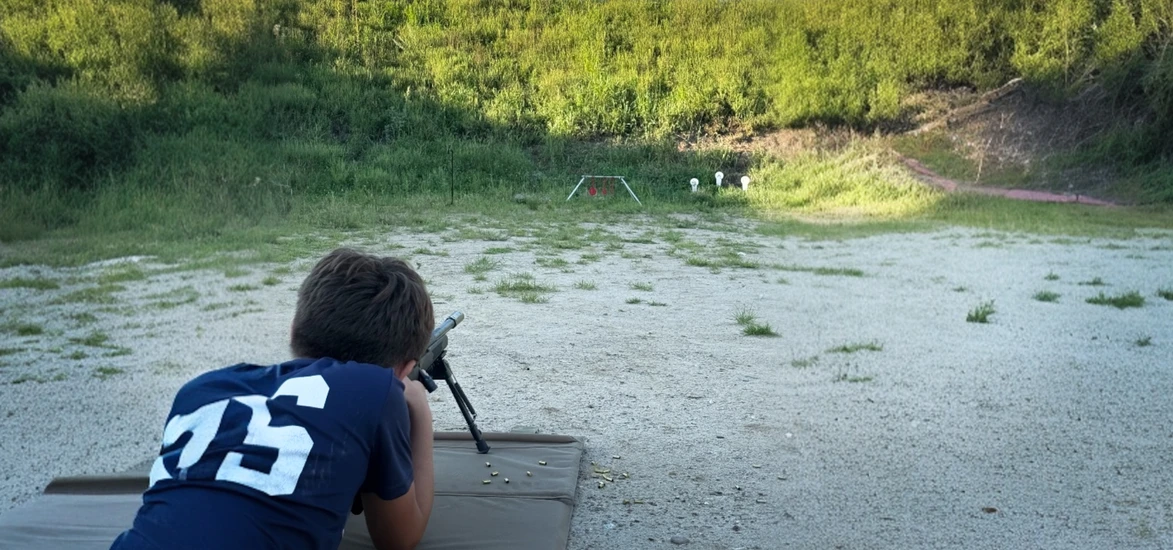
The best steel targets for rimfire are lightweight, appropriately rated reactive targets that give low-energy cartridges enough movement to provide clear feedback. For .22 LR, smaller AR400 plates, gongs and KYL targets are excellent choices for plinking and precision practice. .22 WMR and .17 HMR require more distance and closer attention to the specific target rating because their higher velocity can be much harder on steel than standard .22 LR.
Rimfire is one place where heavier is not automatically better. A thick centerfire rifle plate may survive .22 LR without difficulty, but it may barely move when hit. A purpose-built rimfire target can provide better reaction, easier portability and smaller target sizes that make inexpensive rimfire practice much more challenging.
Best Rimfire Steel Targets at a Glance
| Rimfire Cartridge | Good Target Choice | Shoot Steel General Guidance | Best Use |
|---|---|---|---|
| .22 LR | 1/4″ AR400 rimfire targets | 10 yards minimum on applicable targets | Plinking, KYL, precision and reactive shooting |
| .22 WMR | Target specifically rated for .22 Magnum | Distance varies by target; follow the product rating | Extended-distance rimfire practice |
| .17 HMR | Target specifically rated for .17 HMR | 100 yards minimum on applicable Shoot Steel rimfire systems | Precision rimfire shooting at distance |
Always use the rating for the exact target you own. Different rimfire target designs can carry different minimum distances, especially with .22 WMR and .17 HMR.
Why Purpose-Built Rimfire Steel Targets Work Better
Shoot Steel uses 1/4″ AR400 for many of its dedicated rimfire targets. That is different from the 3/8″ AR500 commonly used for centerfire handgun and short-action rifle targets.
For rimfire shooting, lighter steel has several advantages:
- Better reaction: Lower-energy .22 LR impacts can move lighter paddles and reactive plates more effectively.
- Less weight: A rimfire setup is easier to carry and reposition around the range.
- Smaller targets: Tiny strike faces can create real precision challenges without requiring extreme distances.
- Faster setup: Lightweight stands and plates make portable rimfire ranges practical.
- More useful feedback: A target designed around rimfire energy responds better than an unnecessarily heavy centerfire plate.
AR500 can certainly be used for .22 LR when the specific target is rated for it, but AR500 is not automatically the best answer just because it is harder steel. Purpose-built AR400 rimfire systems can be lighter, more reactive and better suited to the cartridge.
Best Steel Targets for .22 LR
.22 LR is one of the best cartridges for high-volume steel target practice. Recoil is low, ammunition is relatively economical and smaller targets can make even short-range shooting challenging.
For most .22 LR shooters, the best options include:
- Small static plates
- Rimfire poppers
- KYL racks
- Small gongs
- Reactive paddles
- Rimfire-configured moving targets
Shoot Steel's general cartridge guide recommends 1/4″ AR400 for .22 LR with a 10-yard minimum. Product-specific instructions still control, so check the exact target before shooting.
Best .22 LR Target for Plinking
For casual plinking, reactive steel is hard to beat. You do not need to stop and inspect holes in paper after every magazine. A hit gives you immediate movement or sound, and then the target is ready for another shot.
A compact popper is a good example. Shoot Steel's Rimfire Economy Popper uses a 12″ x 6″ target cut from 1/4″ AR400 and mounts to a spring-loaded base so the target reacts while remaining ready for repeated hits.
Best .22 LR Target for Precision Practice
For precision, smaller is better. Instead of constantly moving farther away, reduce the strike-zone size.
A KYL, or Know Your Limits, rack takes that idea much farther by arranging progressively smaller plates. Shoot Steel rimfire KYL systems offer targets ranging from several inches down to fractions of an inch, creating a precision challenge that can be scaled to the shooter.
This makes KYL targets especially useful for:
- Trigger-control practice
- Position shooting
- Precision rimfire competition
- Testing consistency
- Building confidence before moving to smaller plates
What Size Steel Target Is Best for .22 LR?
There is no single best size. Choose based on distance and the level of difficulty you want.
| Target Size | Difficulty | Good Use |
|---|---|---|
| 4″–6″ | Beginner to moderate | General plinking and new shooters |
| 2″–3″ | Moderate | Accuracy and transition practice |
| 1″–2″ | Difficult | Precision rimfire practice |
| Under 1″ | Very difficult | Advanced KYL and precision challenges |
Unlike centerfire rifle shooting, where increased distance often drives the need for larger targets, rimfire gives you the option to create difficulty through very small target sizes.
KYL Targets Are One of the Best Rimfire Training Tools
Few target styles take advantage of rimfire as well as a KYL rack.
The concept is simple: multiple plates decrease in size, and the shooter decides how far to continue. Larger targets build confidence. Smaller targets punish poor fundamentals.
Shoot Steel offers 1/4″ AR400 KYL targets in sizes ranging from 5″ all the way down to 1/4″, depending on the configuration.
A KYL rack can help develop:
- Precision
- Trigger discipline
- Position stability
- Shot-to-shot consistency
- Decision-making under pressure
It is also much more reusable than constantly replacing paper precision targets.
Best Steel Targets for .22 WMR
.22 WMR, commonly called .22 Magnum, should not be treated exactly like .22 LR on steel. It produces considerably more velocity and energy, which means a target rated for .22 LR is not automatically appropriate for .22 WMR.
This is one area where the product-specific rating matters more than a general rimfire label.
Some Shoot Steel rimfire products are rated for .22 WMR, but the required distance varies by design. For example, certain rimfire systems require significantly more distance with .22 Magnum than with .22 LR, while other products are specifically engineered for closer .22 WMR use.
Before shooting .22 WMR:
- Confirm the target specifically lists .22 WMR or .22 Magnum
- Use the published minimum distance for that target
- Inspect the plate regularly for pitting
- Increase distance if the target begins showing surface damage
Do not assume that because both cartridges are rimfire, they can be used interchangeably on every rimfire target.
Best Steel Targets for .17 HMR
.17 HMR presents an even clearer example of why velocity matters.
The projectile is small, but it travels much faster than typical .22 LR ammunition. High velocity can be harder on a steel target than the small bullet diameter suggests.
Shoot Steel's current cartridge guidance recommends 1/4″ AR400 and a 100-yard minimum for .17 HMR on applicable targets. Its current rimfire KYL systems also specify 100 yards for .17 HMR.
For .17 HMR, look for:
- A target specifically rated for .17 HMR
- Small precision plates that make sense at longer distance
- A stable mounting system
- High-contrast target paint for visibility
- Enough range distance to meet the target rating
Do not move an ordinary .22 LR plinking target farther out and assume it is now automatically suitable for .17 HMR. Check the actual product rating first.
Gong vs. Popper vs. KYL vs. Moving Rimfire Targets
Round Gongs
Gongs are simple and versatile. They work well for general plinking and make it easy to create a multi-distance range using different plate sizes.
Best for: Simple setups, plinking, multiple target distances.
Rimfire Poppers
Poppers provide a recognizable vertical target with spring-loaded movement. They work well when you want more visible reaction than a fixed plate.
Best for: General practice, multiple-target layouts and reactive shooting.
KYL Racks
KYL targets prioritize precision by progressively reducing the size of the strike zone.
Best for: Accuracy, competition practice and advanced rimfire shooters.
Moving Targets
Reactive systems add another level of difficulty because the target does not simply remain stationary after each hit. Shoot Steel's Portable Texas Star, for example, can be configured with lightweight 1/4″ AR400 rimfire paddles designed for .22 LR and .22 Magnum.
Best for: Advanced practice, target tracking and shooters who want more than static plinking.
Rimfire Steel Targets vs. Centerfire Steel Targets
The target you use for .22 LR should not automatically be used for every firearm in the safe.
A lightweight rimfire target may be ideal for .22 LR but completely inappropriate for 9mm, 5.56 or .308 unless the product specifically lists those cartridges.
The differences are substantial:
- .22 LR: Dedicated 1/4″ AR400 rimfire targets are a strong choice.
- 9mm: Use a target specifically rated for centerfire handgun ammunition.
- 5.56 / .223: Use rifle-rated steel at the required rifle distance.
- .308: Use an appropriately rated AR500 rifle target at the specified distance.
Never fire a centerfire rifle at a rimfire-only target. A target being made from hardened steel does not mean it is rated for every cartridge.
How to Build a Backyard Rimfire Target Setup
A good rimfire range does not need large targets or complicated stands.
One practical progression is:
- Start with a larger reactive target. Give new shooters an easy hit zone and obvious feedback.
- Add several smaller plates. Use different sizes to create transitions and increase difficulty.
- Add a KYL rack. This creates a dedicated precision station.
- Add a reactive or moving system. Use it for a completely different training challenge.
- Change distance instead of constantly buying more targets. The same plate can become considerably harder as it moves farther away.
Keep all targets in a safe direction with an appropriate backstop. Make sure every target remains within its rated cartridge and distance limits.
Rimfire Target Mounting: Keep It Light and Reactive
A rimfire target should react to a relatively low-energy projectile. That makes mounting especially important.
A plate that is excessively heavy or rigid may survive every hit but provide very little feedback.
Depending on the target design, useful rimfire mounting systems include:
- Spring-loaded static bases
- KYL racks
- Lightweight hanging systems
- Purpose-built reactive stands
- Portable freestanding systems
Use each system exactly as designed. Targets should not be improvised into mounting configurations that change their intended angle or reaction.
Rimfire Steel Target Safety
Rimfire cartridges may be smaller than centerfire ammunition, but steel-target safety still matters.
Follow these basic rules:
- Follow the exact target's minimum shooting distance.
- Use only cartridges listed in the target rating.
- Always use quality eye and ear protection.
- Keep an appropriate backstop behind the target area.
- Shoot perpendicular to the target face when specified by the product.
- Inspect targets and hardware before every session.
- Stop using plates with severe pitting, cratering or deformation.
- Repaint targets regularly so new impacts and surface damage are easy to see.
- Do not use steel-core, armor-piercing or tracer ammunition where prohibited.
One of the most important points with rimfire is that .22 LR, .22 WMR and .17 HMR do not necessarily share the same minimum distance. Higher velocity can dramatically change what the steel experiences at impact.
Common Rimfire Steel Target Mistakes
- Assuming every rimfire target handles every rimfire cartridge. .22 LR, .22 WMR and .17 HMR can have very different target ratings.
- Buying steel that is unnecessarily heavy. A lighter purpose-built rimfire system usually reacts better.
- Assuming AR500 is always better than AR400. Steel grade should match the application.
- Using a .22 LR-only plate with .17 HMR. High velocity can damage a target that handles .22 LR easily.
- Using centerfire ammunition on rimfire-only targets. Never exceed the cartridge rating.
- Choosing targets that are too large. Rimfire is perfect for smaller precision challenges.
- Keeping every target static. Reactive and moving targets are one of the biggest advantages of rimfire steel.
- Ignoring pitting. Increase distance and evaluate the target/ammunition combination if surface damage begins.
Which Rimfire Steel Target Should You Buy?
The best choice depends on what kind of rimfire shooting you enjoy.
- Casual .22 LR plinking: Rimfire poppers, small plates or gongs
- New shooter: Larger reactive plates with an easy-to-see strike zone
- Precision .22 LR: KYL rack with progressively smaller plates
- Competition practice: KYL or other precision-oriented reactive systems
- Advanced reactive practice: Moving systems configured with rimfire-rated paddles
- .22 WMR: Only targets specifically rated for .22 Magnum at the published distance
- .17 HMR: Targets specifically rated for .17 HMR, generally with substantially more distance than .22 LR
- Portable setup: Lightweight 1/4″ rimfire systems
For .22 LR in particular, there is little reason to limit yourself to a large stationary plate. Rimfire gives you the opportunity to shoot smaller targets, build precision challenges and use reactive systems that respond noticeably to every hit.
Frequently Asked Questions
What are the best steel targets for rimfire shooting?
Purpose-built lightweight reactive targets are generally the best choice. For .22 LR, 1/4″ AR400 poppers, KYL targets and other small reactive plates provide a good combination of durability, portability and visible target response.
What is the best steel target for .22 LR?
For general plinking, a lightweight reactive plate or popper is an excellent choice. For precision shooting, a KYL rack with progressively smaller plates provides a more challenging training setup.
Can you shoot .22 LR at AR500 steel?
Yes, when the AR500 target is rated for .22 LR. However, a purpose-built lighter rimfire target may provide better reaction and portability than a heavier centerfire plate.
Is AR500 necessary for .22 LR?
No. Shoot Steel uses 1/4″ AR400 for many dedicated rimfire targets. The lighter steel is well suited to .22 LR and can provide better movement in reactive target systems.
How far away should you shoot .22 LR at steel?
Shoot Steel's current general recommendation is 10 yards minimum for .22 LR on applicable 1/4″ AR400 targets. Always follow the instructions for the exact target you are using.
Can you shoot .22 Magnum at rimfire steel targets?
Only when the specific target is rated for .22 WMR or .22 Magnum. Minimum distance varies by target design and can be significantly greater than the distance required for .22 LR.
Can you shoot .17 HMR at steel targets?
Yes, on targets specifically rated for .17 HMR. Shoot Steel's current applicable rimfire systems specify a 100-yard minimum for .17 HMR because of its higher velocity.
Why does .17 HMR require more distance than .22 LR?
Velocity matters when shooting steel. Although the .17 HMR projectile is small, its higher velocity can be much harder on a target surface than standard .22 LR ammunition.
What size steel target is best for .22 LR?
For beginners and casual plinking, 4″ to 6″ targets provide an easy-to-see strike area. Experienced shooters can move to 1″ to 3″ plates or even smaller KYL targets for a precision challenge.
What is a KYL rimfire target?
KYL stands for Know Your Limits. A KYL rack uses progressively sized steel plates that challenge the shooter to decide how far to continue as each target becomes smaller and more difficult to hit.
Are reactive steel targets good for .22 LR?
Yes. Rimfire is especially well suited to lightweight reactive targets because properly designed paddles, poppers and moving targets can provide clear visual feedback while allowing repeated shooting without resetting paper targets.
Can you use 9mm on a rimfire steel target?
Only if that exact target is also specifically rated for 9mm or centerfire handgun use. Do not assume a rimfire target can handle centerfire ammunition simply because it is made from hardened steel.
Can you shoot 5.56 or .308 at rimfire targets?
No, unless the exact product explicitly carries a centerfire rifle rating. Dedicated rimfire targets should never be treated as rifle-rated AR500 targets.
What should I buy for my first rimfire steel setup?
Start with one larger reactive target for easy hit confirmation and add smaller targets as your accuracy improves. A rimfire popper plus a KYL rack gives you both general plinking and precision practice in the same range setup.