
Steel Target Mounting Systems Explained: Chains, Straps, T-Posts and Stands
28th Jul 2026
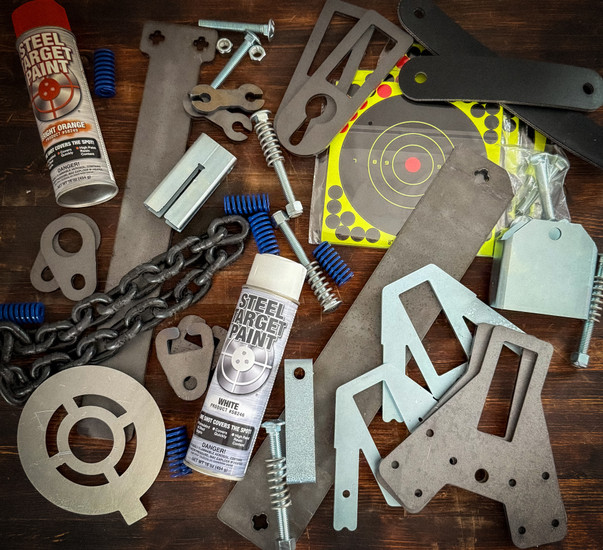
The best steel target mounting system depends on the target and how you use your range. Chains and rubber straps are excellent for hanging gongs, T-post hangers provide a fast and portable setup, and freestanding target stands work well when you want a dedicated static or semi-permanent target system. For most shooters, the goal is the same: securely support the target, allow it to react as designed, direct bullet fragments toward a safer area and make damaged mounting components easy to replace.
Mounting hardware is easy to overlook when buying an AR500 target, but it has a major effect on how the entire system performs. A quality steel plate attached to the wrong hanger can be difficult to set up, constantly turn sideways, destroy hardware or fail to position the strike face correctly.
The right setup starts with understanding the differences between chains, rubber straps, T-post target hangers, 2x4 mounts and dedicated steel target stands.
Steel Target Mounting Systems Compared
| Mounting System | Best For | Main Advantage | Consideration |
|---|---|---|---|
| Chains | Gongs and hanging targets | Simple and easy to replace | Individual links can be damaged by hits |
| Rubber Straps | Reactive gongs and plate racks | Flexible, reactive and resistant to direct hits | Still a wear component that should be inspected |
| T-Post Hangers | Portable ranges and quick setups | Minimal equipment and fast installation | Requires ground that can accept a T-post |
| 2x4 Mounts | Static targets and modular range setups | Wood upright is inexpensive and replaceable | Wood can eventually be damaged by misses |
| Freestanding Stands | Dedicated bays and established ranges | Stable, repeatable target placement | More equipment to transport |
| Reactive Systems | Competition and advanced training | Movement provides immediate visual feedback | Use the mounting system designed for that target |
There is no single best steel target mounting system for every shooter. A 10" gong used on private property has different mounting requirements than a large silhouette used by an instructor or a set of targets moved between competition stages.
Shop Steel Target Stands & Hangers
Chains: The Traditional Way to Hang Steel Targets
Chains are one of the simplest ways to create a hanging steel gong. Attach the target at two points and suspend it from a crossmember or hanger system. When the target is hit, the plate can move rather than remaining completely rigid.
Chains remain popular because they are:
- Simple
- Widely available
- Easy to adjust for length
- Easy to replace
- Compatible with many gong sizes
The tradeoff is that chain is made up of relatively small steel links. A direct hit can damage a link, bolt or quick link and take the target out of action until the mounting hardware is replaced.
If you use chains, keep spare hardware in your range kit. Chains, bolts, straps and similar mounting pieces should be treated as replaceable components rather than permanent parts of the target.
When Chains Make the Most Sense
Chains work particularly well for a range that stays assembled for long periods. If you already have a sturdy crossmember or target frame, they provide a straightforward way to hang multiple gongs.
They are also useful when you want to adjust the height or hanging angle by changing attachment points.
Rubber Straps: A Better Option for Many Gong Setups
Rubber straps for steel targets solve one of the biggest weaknesses of conventional chain: they are designed to tolerate impacts better while keeping the plate suspended.
Shoot Steel's 8" rubber target straps use self-healing rubber designed to take direct hits and continue supporting the target. They can be used with swinging gong setups and are available as replacement mounting components.
Rubber straps offer several practical advantages:
- They allow the target to swing naturally when hit.
- They do not have individual chain links that can be severed.
- The flexible material absorbs movement after impact.
- They help keep reactive targets moving consistently.
- Replacement straps are easy to keep in a range bag.
That makes them especially useful for 9mm steel targets and other handgun setups where visible target movement is part of the shooting experience.
Can Rubber Target Straps Take a Direct Hit?
Shoot Steel's self-healing rubber straps are specifically designed to withstand direct bullet impacts and continue hanging the target. That does not make them indestructible. Repeated impacts will eventually wear mounting components, which is why straps should still be inspected regularly.
If a strap becomes badly torn, stretched or otherwise compromised, replace it before the next range session.
T-Post Target Hangers: Simple, Portable and Fast
A T-post target hanger is one of the most useful mounting options for shooters who want to build a range without hauling a large target frame downrange.
Standard steel T-posts are inexpensive, compact and easy to place in suitable ground. Once the post is installed, the hanger provides the connection between the post and target.
Shoot Steel's AR500 T-Post Gong Hangers are built from 3/8" AR500 steel and designed to slide onto standard 1.25" or 1.33" T-posts. The self-locking design holds the hanger under load without requiring set screws or clamps. Add your rubber strap or chain, attach the gong and the target is ready to hang.
A T-post system works well for:
- Private-property shooting ranges
- Gongs positioned at multiple distances
- Long-range rifle targets
- Temporary range layouts
- Targets that need to be moved seasonally
- Shooters who want to minimize the amount of equipment transported downrange
It also gives you flexibility. Instead of building one large frame that holds several targets, you can place individual targets wherever your range layout requires them.
T-Post Gong Hanger vs. T-Post Static Hanger
These two systems serve different purposes.
A T-post gong hanger gives you attachment points for a suspended target using chains or rubber straps. The gong remains free to swing after impact.
A T-post static target hanger attaches the target directly to the post-mounted hanger. Shoot Steel's static system uses mounting hardware and a spring to hold the plate securely while allowing the target to react as designed.
Choose the gong system when you want movement and traditional hanging-target feedback. Choose the static system when you want a clean silhouette, round plate or A-zone target held in a consistent position.
2x4 Steel Target Stands: Simple Parts, Easy Repairs
A wood 2x4 target stand uses a replaceable piece of standard lumber as the upright between the base and target hanger.
There is a good reason this design remains popular: shooters miss.
If a round strikes the upright, replacing a section of 2x4 is inexpensive and simple. That makes wood uprights practical for training ranges where the stand may see a lot of use.
A 2x4 system is a strong choice when you want:
- A freestanding target instead of driving a post into the ground
- A static silhouette or round target
- A stand that can be repositioned around the range
- Replaceable components in common impact areas
- A setup that works on surfaces where T-posts cannot be installed
For gravel ranges, hard ground or locations where driving posts is not practical, a freestanding base and 2x4 upright can be a better solution than a T-post.
Dedicated Steel Target Stands
A purpose-built steel target stand provides a stable base and consistent target position. Shoot Steel offers static target stand configurations built around T-post, standard 2x4 and heavy-duty 2x4 setups, allowing the support system to be matched to the size of the target and the range environment.
Freestanding stands make the most sense when:
- The ground is too hard for T-posts
- You frequently reposition targets
- You operate a dedicated shooting bay
- You use larger silhouettes
- You want predictable target placement
- You want a complete mounting system instead of building one from separate parts
The downside is transportation. A full stand takes up more room than a T-post hanger or pair of rubber straps. For a permanent range, that may not matter. For someone carrying equipment hundreds of yards downrange, it can.
Should a Steel Target Swing When Hit?
For a target designed as a hanging gong, yes, the target should be able to move freely when struck. Shoot Steel recommends allowing hanging steel to swing because movement helps absorb impact energy.
Movement also provides useful visual feedback. With a distant rifle target, seeing the plate move can confirm a hit when the audible report is delayed by distance.
That does not mean every steel target should swing. Static targets, poppers, plate racks, dueling trees and other reactive systems are engineered to move in specific ways. Use each target with its intended mounting hardware rather than trying to convert every target into a hanging gong.
How Should a Steel Target Be Angled?
Proper steel target mounting angle helps manage bullet fragmentation. Shoot Steel's safety guidance explains that when a projectile strikes hard, flat AR500 steel, the bullet should fragment and be directed downward into the ground when the target is properly set up.
The key is to use the angle created by the target and mounting system. Do not randomly lean a plate forward or backward and assume that makes it safer.
Depending on the system, the target may:
- Hang naturally from straps or chains
- Lean forward through the hanger design
- Use a spring-loaded static mount
- Use a fixed engineered angle for a specialized target
Always follow the instructions for the specific product.
The strike face should also remain smooth. Deep craters and significant pitting can change the direction of bullet fragments. A damaged plate should be removed from service rather than compensated for by changing the mounting angle.
What Mounting System Is Best for 9mm?
For 9mm pistol shooting, you have plenty of good options because a quality AR500 target does not need an extremely heavy mounting structure to handle normal handgun impacts.
For a simple recreational setup, a 3/8" AR500 gong suspended from rubber straps is hard to beat. It provides movement, audible feedback and easy replacement of wear components.
For defensive pistol drills, competition practice or faster transitions, a static silhouette or A-zone target on a T-post or freestanding stand keeps the target face consistently positioned.
For most handgun ranges:
- General plinking: Hanging gong
- Fast setup: T-post system
- Defensive training: Static silhouette
- Competition practice: Static or purpose-built reactive system
- Portable range: T-post or compact freestanding stand
What Mounting System Is Best for 5.56 and .308?
Rifle targets are often positioned much farther downrange, so reliability and simplicity become increasingly important.
A steel gong mounting system works particularly well for 5.56 and .308 because the target can swing after impact and provide visible feedback at distance. T-post gong hangers are useful when you want individual targets spread across a long-range course.
For a .308 target positioned several hundred yards away, you probably do not want to repeatedly walk downrange because a chain slipped, a bracket turned or a target rotated sideways. Use mounting hardware matched to the weight of the target and inspect the complete setup before moving back to the firing line.
Remember that the mounting system does not change the target's caliber or distance rating. Always follow the specifications for the actual plate being used.
Which Target Parts Should You Expect to Replace?
The AR500 plate may be the centerpiece of the system, but the components around it live a hard life.
Common steel target replacement hardware includes:
- Rubber straps
- Chains
- Quick links
- Carriage bolts
- Springs
- Lock nuts
- 2x4 uprights
- Hangers and brackets when damaged
Inspect these components before every range session. Look for cuts, cracks, damaged links, loose fasteners, stretched straps, bent brackets and impact damage.
Keeping replacement hardware on hand is especially important for instructors, range owners and anyone setting targets far downrange. A spare strap or bolt is much cheaper than losing an entire shooting session because one wear component failed.
Common Steel Target Mounting Mistakes
- Putting all the money into the plate and ignoring the mount. The target and mounting system need to work together.
- Making the gong completely rigid. A hanging gong should be able to move as designed after impact.
- Using undersized hardware. Larger targets require mounting components capable of supporting their weight.
- Ignoring direct hits to chains or straps. Inspect mounting components after they are struck.
- Continuing to use badly damaged hardware. Replace compromised straps, bolts, chains or brackets.
- Improvising the target angle. Use the stand or hanger as designed.
- Forgetting about portability. A heavy-duty permanent stand may be unnecessary if you move your targets every range trip.
- Using the wrong mount for the target style. Gongs, static silhouettes and reactive targets are designed to move differently.
- Assuming the hanger changes the target rating. Steel thickness, caliber rating and minimum shooting distance still apply.
Which Steel Target Mounting System Should You Buy?
If you are choosing a system from scratch, match the hardware to how often the range changes.
- Want the simplest gong setup? Use chains or rubber straps.
- Want fewer problems from direct hits to mounting material? Choose self-healing rubber straps.
- Want a lightweight, portable system? Use a T-post hanger.
- Want individual targets spread across a rifle range? T-post gong hangers are an excellent option.
- Cannot drive posts into the ground? Choose a freestanding target stand.
- Want an inexpensive replaceable upright? Use a 2x4-based stand.
- Setting up a dedicated training bay? Consider a heavier-duty static stand.
- Starting with no target equipment at all? A complete target package removes the guesswork of matching the plate, hanger and stand.
The best way to hang steel targets is not necessarily the most complicated. A good mounting system should be secure, easy to maintain, appropriate for the target and simple enough that setting up your range does not become the hardest part of shooting it.
Frequently Asked Questions
What is the best way to hang a steel target?
For a traditional gong, chains or self-healing rubber straps are two of the most practical options. Rubber straps offer excellent movement and are designed to tolerate direct impacts, while chains provide a simple and easily replaceable mounting method.
Are rubber straps better than chains for steel targets?
Rubber straps can be a better choice when you want fewer vulnerable steel links in the mounting system. Shoot Steel's self-healing rubber target straps are designed to take direct hits while continuing to support the target. Chains remain a durable and simple option for many permanent gong setups.
Can Shoot Steel rubber target straps take a bullet hit?
Yes. Shoot Steel's self-healing rubber straps are specifically designed to withstand direct hits and continue hanging the target. They are still wear components and should be inspected and replaced when significantly damaged.
How does a T-post target hanger work?
Shoot Steel's T-Post Gong Hangers slide onto standard 1.25" or 1.33" steel T-posts and lock in position under the weight of the target without set screws or clamps. Chains or rubber mounting hardware then connect the hanger to the target.
Are T-post target hangers good for portable ranges?
Yes. A T-post setup eliminates the need to transport a large target frame and makes it easy to position individual targets at different locations and distances. The ground must be suitable for installing the T-post.
Should a steel gong swing when hit?
Yes. A hanging gong should generally be allowed to swing freely when struck. Movement absorbs some impact energy and provides additional visual feedback to the shooter.
Should steel shooting targets be angled down?
Steel target systems are often designed to present the strike face so bullet fragments are directed toward the ground. Use the angle created by the manufacturer's hanger or stand rather than improvising your own mounting angle.
What is the best target stand for a 9mm range?
A 3/8" AR500 gong on rubber straps, a T-post-mounted target or a freestanding static stand can all work well for 9mm. Choose based on whether you prioritize target movement, portability or a consistent static target position.
What mounting system is best for long-range steel gongs?
T-post gong hangers are an excellent option for placing individual steel targets at different distances. Rubber straps or chains can then be used to suspend the gong and allow it to move after impact.
Can I mount the same steel gong on different systems?
Often, yes, as long as the target's mounting holes and weight are compatible with the hanger and hardware. Check the specifications of both the target and mounting system before changing configurations.
When should steel target hardware be replaced?
Replace straps, chains, bolts, springs or brackets when they become badly cut, cracked, bent, stretched, weakened or otherwise damaged. Inspect mounting hardware before each shooting session.
What is better, a T-post or freestanding steel target stand?
A T-post is usually lighter and simpler for outdoor ranges where posts can be driven into the ground. A freestanding stand is better on hard surfaces, where targets must be moved frequently or when you want a dedicated base and upright system.