
Impact Discipline: How the Right Steel Target Improves Accuracy
23rd Jun 2026
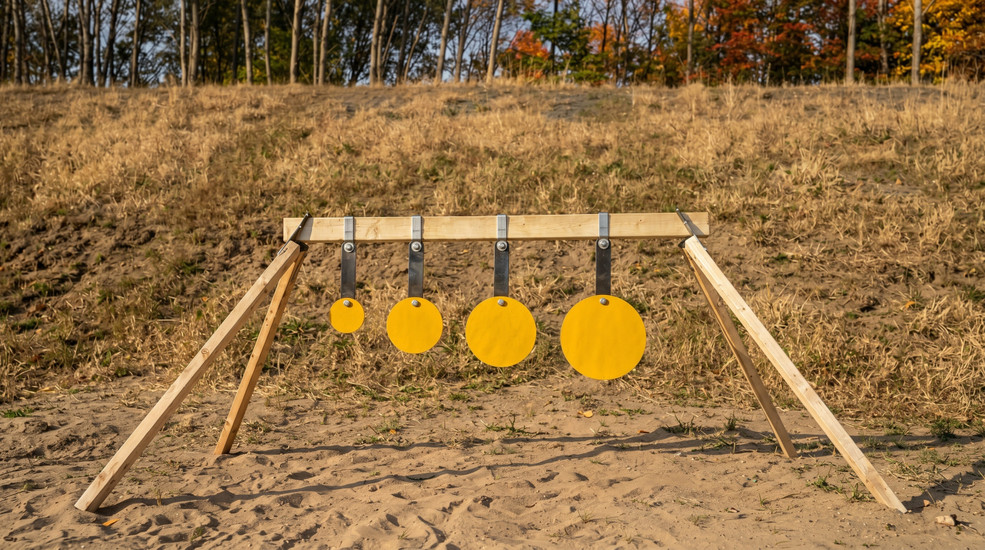
The targets you choose have a lasting impact on your shooting performance. Practicing with the right combination of paper, static steel, reactive steel, and appropriately sized targets helps build better habits, improve consistency, and develop the precision needed for success at any skill level.
It's easy to spend countless hours researching rifle accessories and optics, but many shooters overlook one of the most important pieces of training equipment: the target itself.
This can be a costly mistake because the targets you practice on shape your habits and sharpen your skills more than almost any other accessory. Impact discipline is the calculated process built through technique, skill, and environmental awareness of consistently placing rounds exactly where they belong.
Choosing the right targets ensures every range session moves you one step closer to becoming a more disciplined and capable shooter.
What Your Shots Can Tell You
Every squeeze of the trigger provides valuable feedback. The key is using targets that help you learn from every shot.
Paper Targets
Paper targets clearly show where your rounds land and are excellent for zeroing optics and evaluating shot groups. However, they have one significant drawback: by the time you walk downrange to inspect your impacts, you've often forgotten exactly how your body felt during the shot.
Steel Targets
Steel targets eliminate that delay by providing immediate audible feedback. The instant ring of a successful hit allows shooters to associate proper body mechanics and trigger control with the result in real time. That immediate reinforcement accelerates muscle memory, creates repeatable patterns, and ultimately leads to greater consistency.
It's no surprise that serious training programs increasingly incorporate steel targets because their instant feedback loop promotes faster skill development and better retention.
Why Smaller Targets Increase Your Chance of Success
Many beginners gravitate toward larger targets because they're easier to hit, but consistently hitting a forgiving target doesn't necessarily translate into precision shooting.
What Larger Targets Hide
Large targets often conceal small mistakes. A slight wobble during trigger break or a minor lapse in sight alignment may still result in a hit on a 12 inch plate. Over time, your brain can begin associating imperfect technique with success, something especially problematic when ethical shot placement matters.
Smaller Targets, Bigger Improvements
Smaller targets expose flaws that larger ones hide. Missing a 4 inch or 8 inch plate at distance quickly reveals where your fundamentals need refinement. Conversely, when you connect with a challenging target, your brain reinforces the precise mechanics that made the shot successful.
Shooters who regularly train on smaller targets often find larger targets significantly easier to hit because the precision they've developed transfers naturally to more forgiving engagements.
What Different Target Types Can Teach You
Both stationary and reactive targets deserve a place in a well-rounded training program.
Stationary Targets
Static steel targets and hanging gongs form the foundation of many practice routines. They help build consistency, reinforce fundamentals, and provide excellent platforms for developing precision at nearly any distance.
Reactive Targets
Reactive targets such as Pepper Poppers and Texas Stars introduce movement and decision-making into your training. For example, once a Texas Star begins rotating after the first hit, shooters must adapt their timing and shot sequence. Those who remain calm and adjust accordingly typically experience greater success than those who rush their shots.
The Ideal Practice Session
Real world shooting scenarios rarely involve perfectly stationary targets. As targets move or react dynamically, mental demands increase and factors like elevated heart rate, breathing, and rapid decision-making become more significant.
A balanced training session combines both stationary and reactive target work. Static targets refine precision and consistency, while reactive targets build adaptability, composure, and focus under changing conditions.
Distance Changes the Training Equation
The distance to your target determines which skills are truly being tested.
Close Range
Close-range practice, typically 3 to 10 yards for pistols and out to around 25 yards for rifles, helps develop draw mechanics, grip, stance, and trigger control. While sight alignment errors may still exist, they are often less noticeable at these distances.
Long Range
At greater distances, even small imperfections become obvious misses. A trigger press that produces an acceptable hit at seven yards may completely miss a 10-inch plate farther downrange. Regular long-distance practice sharpens precision and makes close-range engagements feel considerably easier.
How to Progress
Start at a distance where you can maintain roughly a 75–80% hit rate on your chosen target size. Then gradually move back until your success rate falls to around 50–60%. That challenge zone is where meaningful improvement occurs, while remaining inside your comfort zone often limits growth.
The Right Steel for the Job
Selecting the proper target isn't just about choosing between static and reactive designs, it also means choosing steel that matches your firearm and ammunition.
Using incorrect steel thickness can shorten target life, create undesirable splatter patterns, and reduce overall safety. Matching steel appropriately helps maximize durability and performance.
- 3/8-inch AR500 steel: Excellent for general pistol and carbine practice and suitable for many common handgun calibers and lower-velocity rifle applications.
- 1/2-inch AR550 steel: Ideal for higher-velocity rifle cartridges and magnum handgun rounds where additional hardness and longevity are beneficial.
A dependable target builds confidence every time you step onto the range. ShootSteel manufactures targets using premium AR500 and AR550 steel, and its Buyer's Guide offers clear recommendations for selecting the appropriate thickness and steel grade for your application.
Matching Your Targets to Your Optics
Your optic selection has a significant impact on how you should structure your training.
LPVOs
Low Power Variable Optics (LPVOs) offer tremendous versatility. At 1x magnification, shooters can engage close targets quickly using both-eyes-open techniques and speed-focused drills. Increasing magnification to 6x or 8x allows the same rifle to transition seamlessly into precision work on smaller targets at extended distances.
That adaptability makes LPVOs one of the most versatile optic choices available. Fixed higher-magnification scopes can slow close-range reactive shooting, while red dots may limit precision at distance.
If you're still deciding on optics for a training-focused rifle, Freedom Gorilla offers an extensive selection of LPVOs and rifle scopes ranging from entry-level models to competition-grade options from many of the industry's leading manufacturers, making it easy to find glass that matches your shooting style.
Conclusion
The phrase "perfect practice makes perfect" rings especially true when it comes to marksmanship. Deliberate target selection develops disciplined shooting habits that carry over into real-world performance.
Choosing the right target size, steel grade, and training distance and incorporating both stationary and reactive targets into your routine helps build precision, situational awareness, and lasting muscle memory.
Challenge yourself with difficult targets, push beyond your comfort zone, and increase distance until misses provide honest feedback. When your equipment and technique evolve together, every shot becomes an opportunity to improve.
That's the essence of impact discipline.